Everything your site needs for Google and AI search
One crawl covers technical SEO, visibility in AI answers and content that answer engines can quote. Each finding points to the page, the section or the template behind it, ranked by what it costs you.
Technical SEO
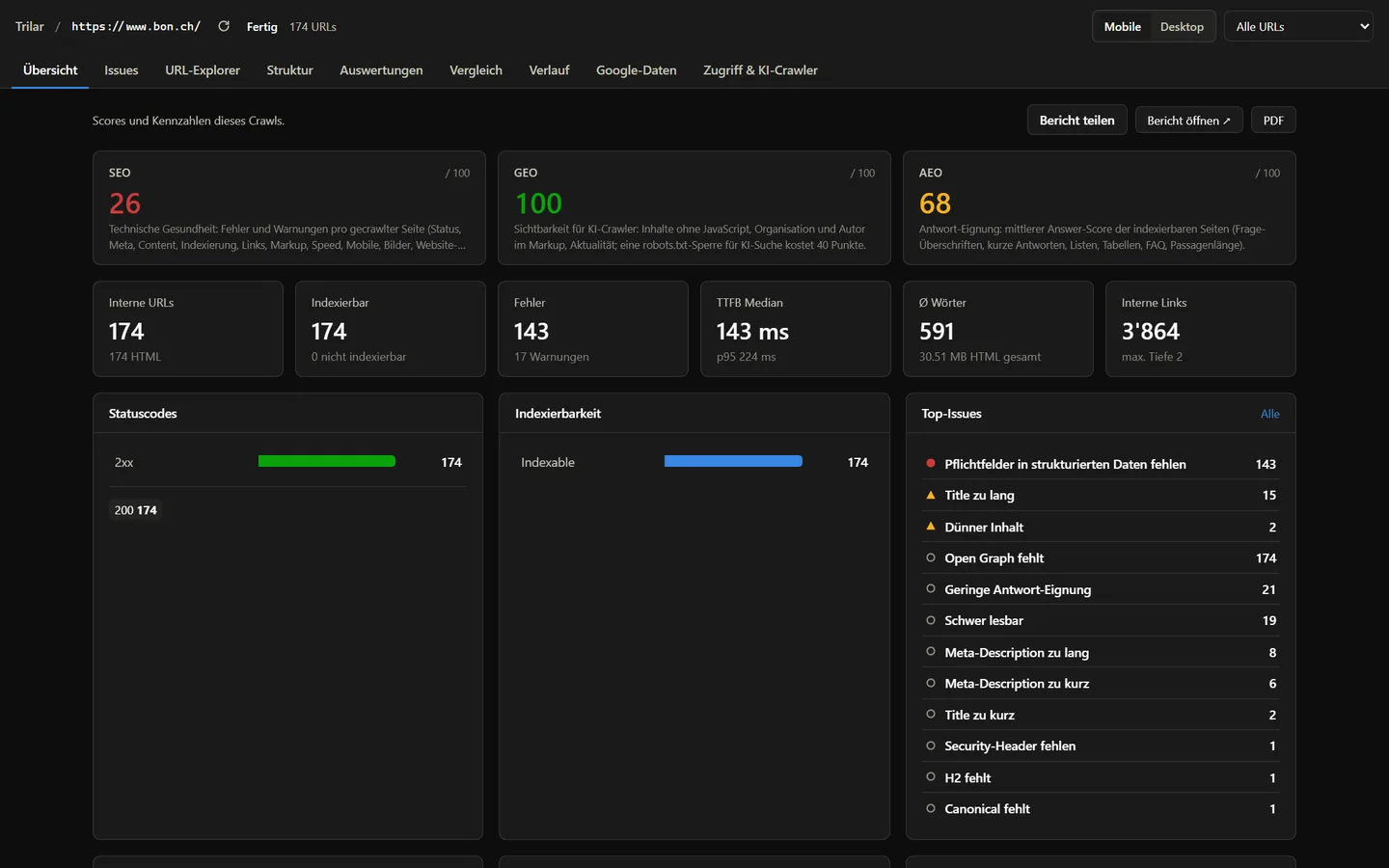
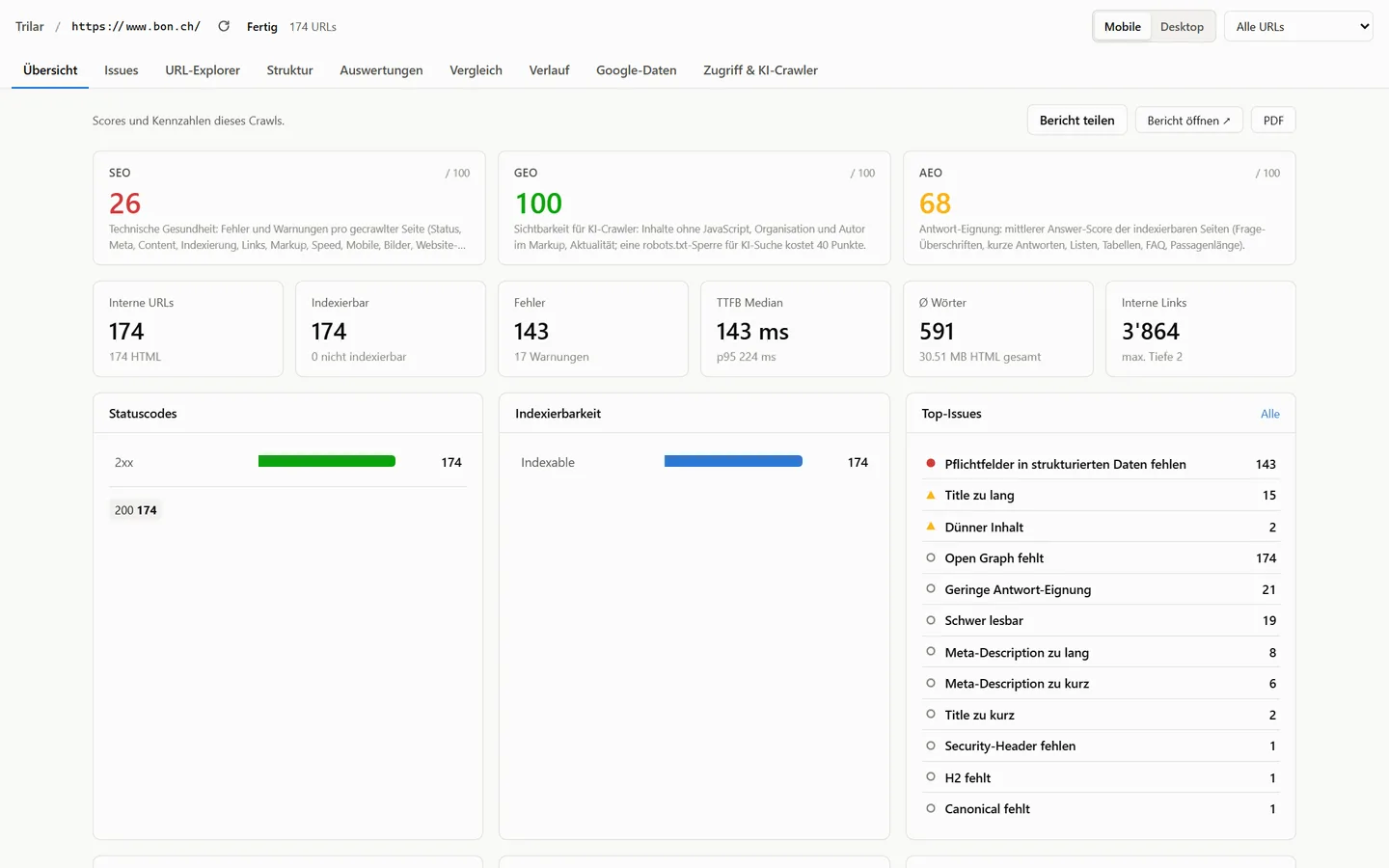
Trilar crawls every URL like Google, renders JavaScript, connects Search Console and Analytics, and turns thousands of findings into a short list of fixes, most expensive first.
Full crawl with JavaScript rendering
Status codes, redirect chains, canonicals, indexability, hreflang, structured data, images, headings, internal links and page speed. Chromium renders pages and shows what only exists after JavaScript.
Problems fixed once, in the template
When almost every page of a type lacks the same thing, the fix is in the shared template. Trilar groups issues by page type and shows which ones a single template change resolves.
Search Console and Analytics per URL
Clicks, impressions, positions and queries against the previous period, sessions and conversions from GA4, Core Web Vitals from CrUX and PageSpeed results, next to the crawl data of each URL.
An action plan instead of a warning list
Redirects that lose rankings, missing content, titles that miss the query and template problems in one list, ranked by impressions and affected pages, ready to export as tasks.
Monitoring and crawl comparison
Scheduled crawls compare themselves with the last run: new errors, fixed issues, changed titles and lost pages. You get an e-mail with the PDF report and a webhook, optionally only when something got worse.
Internal links and site structure
Link score per URL, crawl depth, orphan pages, link opportunities from pages that already mention a query, cannibalisation and wasted link equity.
Generative Engine Optimization
AI search engines answer with a few sources. Trilar shows whether yours is among them, which domains win instead, which of your pages should have been cited and what keeps it from being quoted.
AI visibility for your queries
Trilar asks an AI model with live web search your important queries, taken from Search Console, and records whether your site is cited, at which position and which domains are cited instead.
Why not cited?
For every query without a citation Trilar names the page that should have been cited, its best section, the query words that section lacks, and a verdict: page missing, section missing, section too weak, or good content that loses on authority.
Entities in the Knowledge Graph
Organisations, brands and shops in your structured data, matched with Wikidata by their official website. Trilar lists the sameAs links to Wikidata and Wikipedia that tie your pages to the right entity, and exports them as CSV for your CMS.
Your brand in AI answers
What AI search says when people ask about your brand: is it legit, experiences, alternatives. Trilar checks the answers against your own website and lists wrong claims, the tone, the competitors named and the sources that shape the picture.
AI crawlers and llms.txt
Which AI crawlers robots.txt allows, a live fetch with each bot's real user agent to detect blocks and challenge pages, AI bot visits from your logs, and an llms.txt generated from your crawl.
Answer Engine Optimization
Answer engines retrieve passages, not pages. Trilar splits your content the way they do, scores every section and shows exactly what to add or rewrite.
Citable passages
Trilar splits the main content of every page at its headings and scores each section from 0 to 100: length between 40 and 120 words, a first sentence that names the topic and stands on its own, concrete numbers and facts, and a direct answer under question headings.
Sub-questions (query fan-out)
AI search splits a question into sub-queries and retrieves a passage for each. Trilar has an AI model write those sub-queries for a page and marks which passage answers each one fully, partly or not at all. The gaps are the content to add.
Own text per page
How much of a page is its own content and how much is repeated template text. Thin pages with little own text are hard to cite and easy to ignore.
E-E-A-T
The trust signals of the whole site, without AI: imprint, contact, about and privacy pages and how widely they are linked, your organisation in the schema, and per page author, date, author profiles and editorial review. On request, an AI model rates single pages for experience, expertise, authoritativeness and trust with evidence and fixes.
Content briefs and alt texts
For topics your site lacks, Trilar writes a content brief from your Search Console queries and the pages that rank. For images without alt text it suggests one per image, page by page.
Connected data
Trilar brings the data you would otherwise pull from five exports next to every URL.
- Google Search Console
- Google Analytics 4
- Chrome UX Report (CrUX)
- PageSpeed Insights
- Server logs (log integration)
- Wikidata
- Claude by Anthropic (AI features on request)
- Google Sheets
- Webhooks: Slack, Teams, Make, Zapier
- REST API with keys
Built for teams and agencies
Reports without a login
A link for clients and colleagues, plus the report as PDF by e-mail after each scheduled crawl.
Tasks instead of spreadsheets
Markdown or CSV with page, problem and template, ready for your ticket system.
Comparison and history
Two crawls side by side, page types compared and every site's trend over time.
Site migrations
Check a redirect mapping before and after a relaunch: target reached, chain, error or wrong target.
Try Trilar on your own website
Early access includes onboarding: we set up your account and go through the first crawl with you.